Unity Projects
Unity is a versatile game engine that I've used to create a variety of projects, from solo RPGs to fast-paced jam entries. These games demonstrate my proficiency in C# programming, systems design, and rapid development under time constraints.
Project Overview
Too Deep To Dig is a fully developed solo project where I designed and implemented a complete gameplay loop from scratch. This top-down RPG focuses on replayability and systemic design, combining procedural generation, combat, progression, and economy systems into a cohesive and scalable architecture.
The goal of the project was to create a game that feels different every run while maintaining consistent player progression and challenge balance.
Key Features
Procedural Dungeon Generation
Custom room-based procedural generation system with validation rules to ensure playable layouts, connectivity, and balanced difficulty progression.
View ImplementationQuest System
Modular quest architecture supporting multiple objectives and state transitions, designed for easy expansion and content scalability.
View ImplementationProgression System
Player progression framework handling stats, scaling, and upgrades, enabling consistent difficulty curves and long-term engagement.
View ImplementationCombat & Spell System
Real-time combat system with extensible architecture for weapons, abilities, and enemy behaviors, including spell interactions and damage handling.
View ImplementationNPC Interaction System
Dialogue and merchant system supporting player interaction, item transactions, and state-based responses for immersive world building.
View ImplementationMonster Ability System
Specialized system for enemy abilities and behaviors, enabling diverse combat scenarios and unique enemy mechanics.
View ImplementationMy Role & Responsibilities
This was a fully solo project where I was responsible for the entire development pipeline:
- Game design and core systems architecture
- Gameplay programming (C# / Unity)
- Procedural generation design and implementation
- UI/UX development and player feedback systems
- Performance optimization for PC and mobile
- Testing, balancing, and iteration
Technical Highlights
- Room-based procedural generation with validation rules to prevent broken layouts
- State-driven AI architecture for enemy behaviors
- Modular gameplay systems (combat, abilities, economy)
- Save/load system with persistent progression
- Mobile optimization (memory and performance constraints)
Key Challenges & Solutions
- Challenge: Generating levels that are both random and playable
Solution: Implemented constraint-based generation with validation passes to ensure connectivity and balance - Challenge: Maintaining scalable code as systems grew
Solution: Designed modular systems with clear responsibilities, enabling easier iteration and feature expansion - Challenge: Performance on mobile devices
Solution: Optimized update cycles, reduced allocations, and simplified runtime calculations
Lessons Learned
- How to design scalable gameplay systems instead of one-off features
- The importance of iteration and fast testing loops
- Balancing system complexity with player clarity
- Managing scope and priorities in a solo project
Purgatory (Brackeys Game Jam 2026.1 – 72h)
Overview
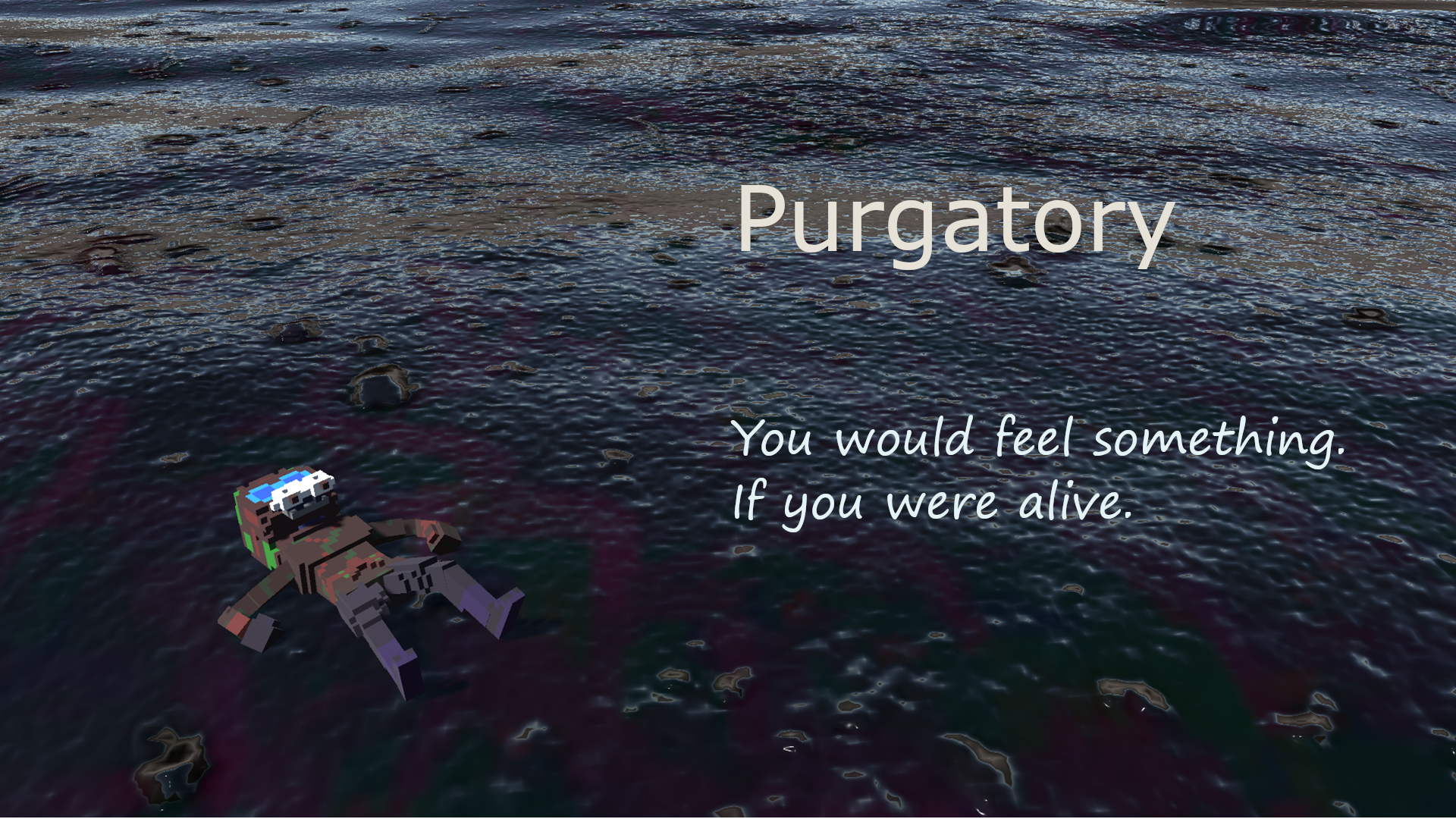
Purgatory is a top-down shooter developed in 72 hours, set in a minimalistic yet conceptually complex environment. The game explores themes of perception and reality within a post-apocalyptic setting, where what the player sees may not reflect what is actually happening.
Highlights
- Perception-Based Design: Gameplay and environment are built around the idea that reality is not what it seems, encouraging player interpretation and discovery
- Minimalist Yet Complex Environment: Visual simplicity combined with layered design decisions to create depth and ambiguity
- Top-Down Combat: Fast-paced shooting mechanics integrated with exploration and narrative cues
- Atmosphere Through Design: Use of space, pacing, and audio to reinforce tension and post-apocalyptic tone
- Rapid Development: Fully playable experience designed and implemented within a 72-hour game jam
Sem Brincadeira (Next Level Game Jam 2024 – 48h)
Overview
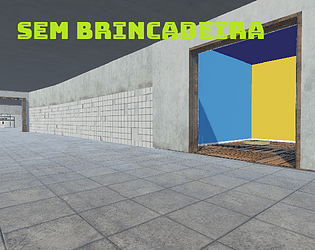
Sem Brincadeira is a first-person puzzle experience developed in 48 hours, featuring a dark and unsettling atmosphere. Due to the strict time constraint, the project focuses on a minimal but cohesive gameplay experience, prioritizing mood, pacing, and a clear core mechanic.
Highlights
- First-Person Puzzle Design: Core gameplay centered around a simple but effective puzzle mechanic integrated into the environment
- Atmosphere-Driven Experience: Use of lighting, sound, and spatial design to create a dark and immersive tone
- Scope Reduction Strategy: Significant feature cuts to ensure a polished and complete experience within 48 hours
- Focused Gameplay Loop: Prioritization of clarity and player guidance over feature complexity
- Rapid Development: End-to-end implementation under extreme time constraints while maintaining cohesion
The Search Of Life (GameDev.TV Jam 2023 – 72h)
Overview
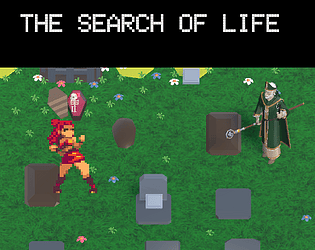
The Search Of Life is a beat 'em up experience developed in 72 hours, combining 2D and 3D elements to create a unique visual and gameplay style. The game focuses on a single boss encounter, delivering a concise but impactful experience with a narrative twist.
Highlights
- Single Boss Design: Entire gameplay structured around one carefully designed encounter, emphasizing combat clarity and player engagement
- 2D/3D Hybrid Approach: Combination of visual styles to create a distinctive aesthetic and demonstrate technical flexibility
- Focused Combat System: Beat 'em up mechanics designed for responsiveness and immediate player feedback
- Narrative Twist: Short but memorable story element that recontextualizes the experience
- Creative Scope Management: Strategic decision to center the experience on a single encounter to ensure polish within 72 hours