Unreal Engine Projects
Unreal Engine is my preferred development environment, where I've created several projects that showcase my skills in Blueprint visual scripting and C++ development. These projects demonstrate my ability to leverage Unreal's powerful features to create engaging and visually impressive experiences.
Stand For Amazonian Forest
Project Overview
Stand For Amazonian Forest is a turn-based tactical game developed in Unreal Engine, focused on systemic gameplay and environmental storytelling. The project was designed to explore how game mechanics can reinforce real-world themes, combining strategy, resource management, and reactive systems.
The core objective was to build a scalable turn-based system that balances strategic depth with player clarity, while integrating environmental mechanics directly into gameplay decisions.
Key Features
-
Turn-Based Combat System (Blueprint):
Grid-based tactical system with turn management, unit actions, and state transitions, fully implemented in Unreal Engine Blueprints.
View Blueprint System (.uasset files) -
Multi-Unit & Faction System (Blueprint):
Supports multiple controllable units across two distinct factions (insects and machines), with modular character logic and shared behaviors.
View Character Blueprints (.uasset files) -
Hexagonal Grid & Terrain System (Blueprint):
Hex-based grid implementation with multiple terrain types affecting gameplay, positioning, and tactical decisions.
View Grid & Terrain Blueprints (.uasset files) -
Spell System with VFX (Blueprint):
Ability system supporting multiple spell types, integrated with visual effects for player feedback and combat clarity.
View Spell Blueprints (.uasset files) -
Enemy AI System (Blueprint):
AI decision-making system using Unreal’s AI framework, handling enemy behavior, targeting, and tactical responses.
View AI Blueprints (.uasset files) -
Player Action Manager (Blueprint):
Centralized system controlling player inputs, action validation, and interaction flow across gameplay systems.
View Core Gameplay Blueprints (.uasset files)
My Role & Responsibilities
- Game design and core systems architecture
- Implementation of gameplay systems using Blueprint and C++
- Turn-based system design and state management
- AI behavior design and balancing
- UI systems for player feedback and decision clarity
- Gameplay balancing and iteration
Technical Highlights
- Grid-based movement and action system implemented in Blueprint
- State-driven architecture for turn management and game flow
- Behavior Tree-based AI for enemy decision-making
- Modular systems enabling rapid iteration and scalability
- Custom UI elements for displaying game state and player options
Key Challenges & Solutions
- Challenge: Designing a turn-based system that feels intuitive without oversimplifying strategy
Solution: Built a state-driven flow with clear player feedback and structured turn phases - Challenge: Balancing strategy depth with accessibility
Solution: Iterative tuning of mechanics and constraints to maintain meaningful decisions without overwhelming the player - Challenge: Integrating environmental themes into gameplay systems
Solution: Connected player actions directly to world state changes, reinforcing the theme through mechanics instead of narrative alone - Challenge: Creating AI that is challenging but fair
Solution: Implemented Behavior Trees with controlled decision logic and predictable patterns
Lessons Learned
- Designing systems where mechanics reinforce thematic goals
- Structuring turn-based gameplay for clarity and scalability
- Using Blueprint effectively for rapid prototyping and iteration
- Balancing player freedom with system constraints
ToVRe Defense
Project Overview
ToVRe Defense is a VR turret-based shooter developed in Unreal Engine, focused on delivering a comfortable and immersive experience through controlled player movement and optimized interaction systems.
The project explores how to design engaging gameplay within VR constraints, prioritizing performance, player comfort, and intuitive interaction design.
Key Features
-
VR Interaction System (Blueprint):
Custom interaction framework for VR controls, handling input, weapon interaction, and player feedback within a 3D spatial environment.
View VR Blueprints (.uasset files) -
Turret-Based Gameplay System (C++):
Core gameplay implemented in C++, controlling player behavior, turret mechanics, and interaction logic for a stationary VR experience.
View C++ Implementation -
Wave-Based Enemy System (Blueprint):
Enemy spawning and progression system with increasing difficulty and varied enemy behaviors across waves.
View Enemy Blueprints (.uasset files) -
Score System (C++):
Centralized scoring system handling player progression, score tracking, and gameplay feedback.
View C++ Implementation -
Weapons & VFX System (Blueprint):
Projectile and visual effects system supporting multiple weapon types, enhancing feedback and combat readability.
View VFX & Projectile Blueprints (.uasset files)
Note: High-quality third-party assets were integrated and customized to support gameplay systems and visual fidelity.
View Project AssetsMy Role & Responsibilities
- Design and implementation of VR gameplay systems
- Development of interaction and control mechanics
- Performance optimization for VR requirements
- Enemy behavior and progression system design
- UI and feedback systems for spatial interaction
- Gameplay balancing and iteration
Technical Highlights
- Custom VR interaction system for turret control and weapon handling
- Hybrid architecture using C++ (performance-critical systems) and Blueprint (iteration and gameplay logic)
- Wave-based spawning system with difficulty progression
- Spatial audio integration for improved immersion and player awareness
- Score and progression tracking system
Key Challenges & Solutions
- Challenge: Preventing motion sickness in VR gameplay
Solution: Designed a stationary turret-based system, eliminating artificial locomotion while maintaining engagement - Challenge: Maintaining high and stable frame rates
Solution: Optimized rendering and gameplay systems, prioritizing performance-critical logic in C++ - Challenge: Creating intuitive VR interactions
Solution: Developed simplified and responsive control schemes tailored for VR input devices - Challenge: Keeping gameplay engaging without player movement
Solution: Focused on enemy patterns, wave design, and reactive combat systems
Lessons Learned
- Designing gameplay around VR constraints instead of adapting traditional mechanics
- Balancing performance and visual fidelity in VR environments
- Combining Blueprint and C++ effectively for both iteration and performance
- Improving player feedback in 3D spatial environments
Unreal Engine Skills Showcase
These projects demonstrate my proficiency with various aspects of Unreal Engine development:
Blueprint Visual Scripting
Creating complex gameplay systems and mechanics using Unreal's node-based programming system, allowing for rapid prototyping and iteration.
C++ Programming
Implementing performance-critical systems and extending engine functionality through custom C++ code, integrated with Blueprint systems.
VR Development
Designing and implementing immersive virtual reality experiences with comfortable, intuitive interactions and optimized performance.
UI/UX Design
Creating user interfaces that provide clear information and feedback while maintaining immersion in the game world.
Game Systems Design
Designing and implementing core gameplay systems like combat, progression, and resource management that create engaging player experiences.
Performance Optimization
Ensuring smooth gameplay across different platforms and hardware configurations through careful optimization of assets and code.
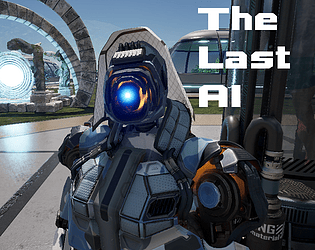
The Last AI (Epic Megagames Jam 2023 – 72h)
Overview
The Last AI is a top-down shooter developed in 72 hours, focused on fast-paced combat and continuous player engagement. The game features an infinite-life loop, encouraging players to push forward against increasingly intense enemy encounters within a high-detail environment.
Highlights
- Top-Down Shooter Gameplay: Responsive combat system designed for fast decision-making and constant action
- Infinite Loop Design: No traditional fail state, shifting the focus to endurance, experimentation, and progression through repeated attempts
- High-Detail Environment: Use of high-polygon assets to create a visually dense and immersive scenario within tight development constraints
- Narrative Twist: Concludes with a surprising ending that reframes the player's experience
- Rapid Development: Full playable experience designed and implemented within a 72-hour game jam timeframe
Upcoming Unreal Engine Projects
I'm currently working on several new Unreal Engine projects that will further showcase my skills and creative vision:
- Procedural World Explorer: An open-world adventure game with procedurally generated environments and dynamic ecosystems
- VR Interactive Narrative: A story-driven VR experience that explores new approaches to narrative in virtual reality
- Multiplayer Tactical Game: A team-based tactical game that builds on the systems developed for Stand For Amazonian Forest
These projects will incorporate advanced Unreal Engine features like the Chaos physics system, Niagara particle effects, and multiplayer networking.